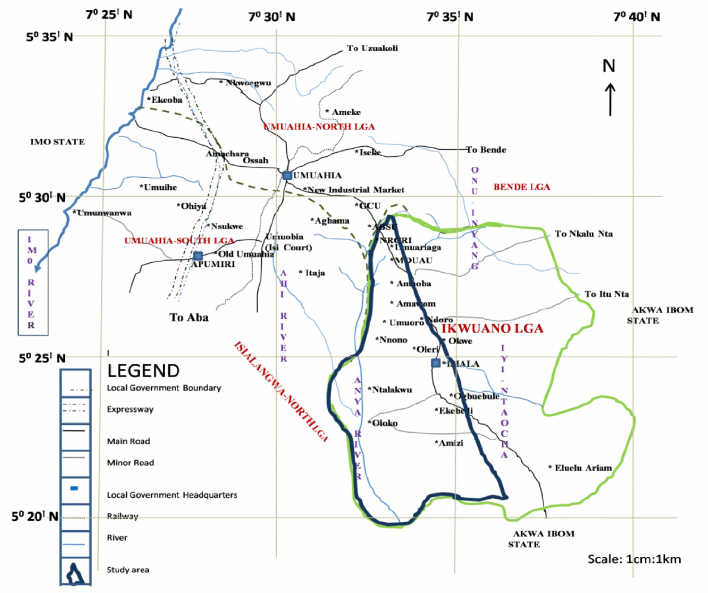
THE ADMINISTRATIVE AND HISTORICAL BACKGROUND OF IKWUANO LOCAL GOVERNMENT AND IKWUANO DEVELOPMENT UNION (FEDERATED)
The end of the Aro expedition and the capture of Arochukwu in (1902), following the destruction of Ibini Ukpabi shrine ended the slave trade. To finally close the traffic on slaves, a native court was established in Bende, which was an access route for slave traffic. This Bende native court became the headquarters for the administration of a group of eighteen (18) clans which together were called Bende Division. The eighteen clans were Bende, Itu, Ozuitem, Uzuakoli (later Umuimenyi), Alayi, Igbere, Item, Abam, Abriba, Ohafia, oloko, Oboro, Ibere and Ariam, Ibeku, Ohuhu, Olokoro, Ubakala and Umuopara). The District officer in Bende, Mr. Cockrail reported to Owerri as Bende was administered as a district of Owerri Province under a commissioner, Sir Ralph Moor.
Warrant Chiefs (artificial Chiefs) were created by the British to govern the Igbo people so as to establish a single ruler in each province and district. Igbo land did not have a centralized authority like other empires. Warrants simply meant certificates of authority to rule over their people.
In 1904, during the tenure of Mr. Hives as District Officer (DO) from Bende, four (4) additional native courts were established and warrant chiefs were appointed to these four courts. Mr. Hives grouped the clans according to their lineage.
Bende native court served Bende, Itu, Ozuitem, Abam, Abiriba and Uzuakoli.
Ohafia native court served the various village of Ohafia.
Alayi native court served Alayi, Item and Igbere clans.
Olokoro native court served Olokoro, Ibeku, Ohuhu (formerly Igbo) and Ubakala.
Oloko native court served Oloko, Oboro, Ibere and Ariam/Usaka.
These five (5) native courts served as sub-administrative headquarters through which effective administration of the 18 clans were carried out. Note that the 18 clans were not a creation of the colonial masters. They were a natural grouping by lineage and relationship. At no time during the history of the native courts was there a merger of clans. Meetings were held by the successive District officers separately with these clans at their respective courts. This system of administration lasted from 1904 till 1929.
When the women’s resistance ended the warrant chief system (1929 – 1930):
After the judicial inquiry of the women’s resistance in 1930 (The inquiry started at Government College, Umudike and later continue at Aba) each of the 18 clans had a native court established in them. The District Officers ruled these clans as sole native authority through the clan councils. This new system of administration was one of the fall outs of the women’s resistance (Ogu Umunwanyi/Ogu Ndem) and brought further decentralization as each clan was more or less granted autonomy.
Federal Treasuries: 1932 – 1938
In 1932, Mr. C. J. Mayne assumed office in Bende as Senior Divisional Officer, and established Federal Treasuries in 1937/38. Bende Division was divided into four federal treasury areas, and in order to avoid controversy in nomenclature, these federal treasuries were classified from the cardinal bearing. Thus, Owuwa Anyanwu (East Federal Treasury comprised Ohafia, Abam and Abiriba clans); Odida Anyanwu (West Federal Treasury comprised Ibeku, Olokoro, Ubakala and Ohuhu clan); Elu Elu (North Federal Treasury comprised Bende, Itu, Ozuitem, Uzuakoli (Umuimenyi), Alayi, Igbere and Item clans); Ala Ala (South Federal Treasury comprised Oloko, Oboro, Ariam and Ibere clans).
There was a further innovation in the administrative machinery. Four (4) courts of appeal were established in these four federated treasury areas. In all these administrative arrangements, Ala Ala (which later became Ikwuano) was never grouped with any of its counterpart councils.
Local Governments
Before the advent of colonial rule in Nigeria local administrations had developed, naturally. There were traditional institutions in operation across the country, upon which the colonialists built the native administration. The Igbo kingdom operated a family/compound-controlled system with representatives of family/compound forming the leadership structure in each community.
At the arrival of the colonialists, and after Lagos became a standalone protectorate, the Eastern region was the first to initiate a radical change in the operation and administration of local government in 1950. The reason for this was the region’s dissatisfaction with the native authority not only because of the nature and custom of the easterners but also because of corruption and high handedness of colonial stooges termed warrant Chiefs.
In 1955, local government was introduced in the former Eastern Region of Nigeria. The Treasury areas became Rural District Councils of the then Bende Division and were known as Owuwa Anyanwu RDC, Elu Elu RDC, Odida Anyanwu RDC and Ala Ala Rural District Council (RDC), in that same year (1955) Umuahia Township was carved out from Odidia Anyanwu as a standalone urban council. In 1959, Ala Ala changed her name to Ikwuano.
Ikwuano was thus an autonomous council when Nigeria became independent. Ikwuano (Ala Ala) was not only autonomous but viable and buoyant. The council maintained all her services, example, dispensaries, courts, maternities, roads, schools. Ikwuano (Ala Ala) was never in deficit not ever indebted to any other council or government. She paid her tax and rates like other counties, as at and when due.
In 1954, an Ikwuano son, Augustine Ukattah was elected member of the Federal House of Representatives for Bende Division. In 1959, he became a Senator. He was the first Chairman of the defunct Ikwuano Council, and for many years President of both Ikwuano and Oloko Clan Unions. In 1961, Chief Augustine Ukattah acted as Senate President of Nigeria, holding brief for Barrister Dennis Osadebay.
In 1961, Ikwuano was granted a seat in the Eastern House of Assembly as evidence of its viability as a council. Barrister (later) Hon. Justice Ferdinand Ifenkwe Ewelike Ukattah was elected to occupy that position from 1961 – 1966 when the Army struck.
It was therefore shocking and humiliating when Ikwuano workup in 1967 to find herself merged with Umuahia as an urban division. This was the lowest fall in the history of Ikwuano as this merger aimed at erasing the identity of Ikwuano. There was no basis for this merger. There was no justification either by history, anthropology or even by the historical British Colonial administration evolution as narrated above. The Ikwuano Divisional Union (as it was then called) protested immediately to the government but the Government of the day failed to rectify this administrative anomaly. During the war, however, three different Divisional Officers – first Mr. G. O. Inyama, next Mr. J. U. Uguru and finally Dr. Iwuagwu respectively were appointed as Sole Administrators to work at Ikwuano. This was hope rising and Dr. Iwuagwu worked with Ikwuano till the end of the war.
Sadly, nobody of the District Officer Cadre was sent after the cessation of hostilities instead, Ikwuano began to be administered from Umuahia in a contraption called Ikwuano-Umuahia. The battle continued under the leadership of the Ikwuano Progressive Union.
Ikwuano Development Union.
Ikwuano Development Union Federated (IDUF) owes its origin to a fraternal visit of Mr. Augustine Echewodo Ukattah to his elder Mr. Rufus Ukattah at Calabari in 1955. During this private visit, Mr. Augustine Ukattah (not a Senator at the time) was hosted by Ala Ala (Ikwuano) persons in the traditional Ikwuano hospitality. At this “Umunna” meeting, the advisability of initiating a more permanent union of Nde-Ikwuano living in Calabar was conjectured, agreed to, and a Union, Ala –Ala Progressive Union was born. Other Ikwuano sons who were present and instrumental to the formation of the Union included Chief Iteogu (Ibere), Peter Spenkwe (Oloko), Peter Nwabende Akobundu and Nwokocha (Oloko).
Among the key objectives in its initial constitution was
“To provide a channel through which all matters affecting Ala – Ala (Ikwuano) can be presented to the government”.
The following year, Mr. Augustine became more intentional about setting a national Ala – Ala Progressive Union. He visited his uncle and mentor Chief Matthew Ugoani at Onitsha and in a similar reception, but more intentionally, a union named Ala-Ala Progressive Union was formed at Onitsha. As the years rolled by the Lagos Branch, Kano and Enugu Branches of the Union became functional and gave identity to Nde-Ikwuano at meetings of the Ibo Union nationally.
When Ikwuano was merged with Umuahia in 1967, Ikwuano people through the now active Ikwuano Progressive Union saw this merger as an affront. The Union led many protests to the government of the day. The merger, rather than improve the lives of Nde-Ikwuano relegated them to abject poverty, undue deprivation, denial of their rights and amenities. Nde-Ikwuano were discriminated at, subjected to indignity and denied such rights as scholarships, appointments, to either divisional boards or committees.
Many a time, the people of Ikwuano were not invited to classified meetings of the Umuahia Division to which they had been forced without their input. In many occasions the reasons adduced for not inviting them to meetings were as flimsy as “there is no road to the place”, ” We couldn’t deliver their letter, ” There was no address”. In areas such as appointments, promotions, transfers, discipline of teachers and so on, as spelt out in unmistakable terms by law, Ikwuano people were denied their rights and were ill-treated.
As the marginalization became routine, the Progressive Union resumed the agitation for the restoration of an Ikwuano Local Government Area. The fresh agitation started in 1974 at the time of the former East Central State. For the first time, the Union joined forces with the Clan Heads (later Traditional Rulers/Ndi-Eze). There was proper and purposeful understanding and coordination between the home-based Union and the branches of the Union across the country.
The Clan Heads were united in the common quest for a local government area of our own. These clan Heads: Chief Joseph A. Otutubuike, Chief Johnson Uwanna (Ibere), Gilber Gbufor (Ariam- Usaka), Robert Okoro and Later Okeiyi (Oboro). At the forefront at the Union level were Senator (Sir.) A. E. Ukattah, Okiyi, U., Osoagbaka (Later Eze Professor), A. I. Egesie (Later HRH); Ebenezer Kanu Chief John Nwaoha (JP), Dr. G. O. Arungwa, R. N. Mba, F. O. Ukoha, Chief M. O. Chinke, Mr. Ajandu, Chief S. O. Chinke, C. Ohuege, Dr. I. N. Eleazu, B.U. Okochi, John O. Nwamuo, M. O. Otuije, Chief Agbai, Mazi P. S. Okwum (VP Ikwuano Divisional Union) O. C. Onyekwere, Ralph U. Ogbonna, O. T. Ajiri, N. E. Ajaka, P.S. Nwokoma, A. S. Nwachukwu, Okwu Enyia, Jacob Nkume, Dr. Elekwachi Nwogbe, A. Atuonwu, Dr. E. C. Ndimele; Dr. Ifenwata, Comfort Amajo; Mrs. Beatrice Uchegbue, O. N. Chionuma, Engr. F. E. Ebilla, and a host of other Union members.
Finally in 1991, the pressure yielded result as Ikwuano Local Government was created by official gazette although it had been in existence as far back as 1959.
These details have become necessary to emphasize that it is the Union that leads development and makes the politicians responsible not the other way round. It is the Union, led by Senator A. E. Ukattah and supported by Ibeabuchi Eleazu that moved the motion to change the name of the headquarters of the Local Government from Mbiopong to Isiala Oboro.
Senator Ukattah was the first President General (PG) of Ikwuano Divisional Union (later Development Union), (1955 – 67). After the Nigeria-Biafra war (1967 – 1970), Senator A. E. Ukattah and Dr. (later Eze Professor) O. U. Osoagbaka reorganized the Union and encouraged three great sons of Oboro,, in quick succession, (Ebenezer Kanu, Ibeabuchi N. Eleazu (Interim) and Col. Ogbonna Orji) to lead the Union. All through this period, Mr. Tom I. Nwaosu of Ahaba Oloko was the Secretary General, while also serving as President of Oloko Clan Development Union. The leadership of the Ikwuano Divisional Union under Col. Ogbonna Orji (Rtd) and Tom Nwosu recaptured and relaunched the Ikwuano Local Government on 31st July, 1982.
The 5th President of Ikwuano Divisional Union was Mr. John Nwaoha of Ibere. He was also the President Customary Court and ensured the stabilization of customary justice in Ikwuano. It was often said of Chief John Nwaoha that no case he adjudicated could lose an appeal because he was considered thorough and detailed. However he was so engrossed with the Customary court duties that he had little time for the Union.
The 6th President General of Ikwuano Development Union Federated was Dr. Eugene C. Ndimele who later became the traditional ruler of Awom-na-Uzie Autonomous Community and later Chairman Ikwuano Council of Ndi-Eze. His reign as PG of IDUF led to the final recapture of the Local Government.
Dr. Anyadiegwu Charles Uzondu who became the 7th President General of IDUF on the invitation of Ikwuano Council of Traditional Rulers in 2010, was to complete the tenure of Dr. E. C Ndimele after the later became a traditional ruler. Among the achievements of the Union as led by Dr. Uzondu are(1) Commemoration of 21-years anniversary of the Ikwuano LG with the Publication of a Compendium of Ikwuano History and Institutions (2) Registered the Union with the Corporate Affairs Commission (CAC); (3) Produced first ever Ikwuano Clans Economic Empowerment and Development Strategy (ICEEDS), a guiding blueprint for the development of the Local Government, a document already being used by the state and local government to prioritise each. Clan/community nerd. (4) Returned the decision-making process on development of Ikwuano to the people by engaging, guiding and ensuring political leadership is inclusive, transparent, accountable and focused on the people’s priorities.
Source:
Courtesy of Ikwuano Development Union-Federated
A NARRATIVE BY
ANYADIEGWU CHARLES UZONDU Ph.D
PRESIDENT GENERAL, IKWUANO DEVELOPMENT UNION